Articles and Advice
Honest bike reviews, practical maintenance guidance, trip-planning advice and lessons learned from real adventures. Everything here is shaped by years of riding, testing bikes and exploring the sealed roads and gravel tracks of South Australia and beyond.
Real bikes. Real rides. Advice earned on the road.
YOUR FIRST GRAVEL RIDE New to gravel? Start here. That first moment when the bitumen ends can be intimidating. The bike starts moving around, the front wheel feels different and suddenly you're wondering what you've got yourself into. Don't worry — we've all been there. Our beginner's guide covers the basics of gravel riding, including braking, cornering, standing on the pegs, choosing your pace, dealing with loose surfaces and building confidence without trying to keep up with experienced riders. You don't need an expensive bike or years of off-road experience. Start slowly. Learn every ride. And welcome to the Pack.
Your First Gravel Ride
What New Adventure Riders Need to Know
There is a moment almost every adventure rider remembers.
The bitumen ends.
Ahead of you is a gravel road disappearing around a corner, and suddenly the motorcycle that felt completely natural five minutes ago feels slightly less certain beneath you.
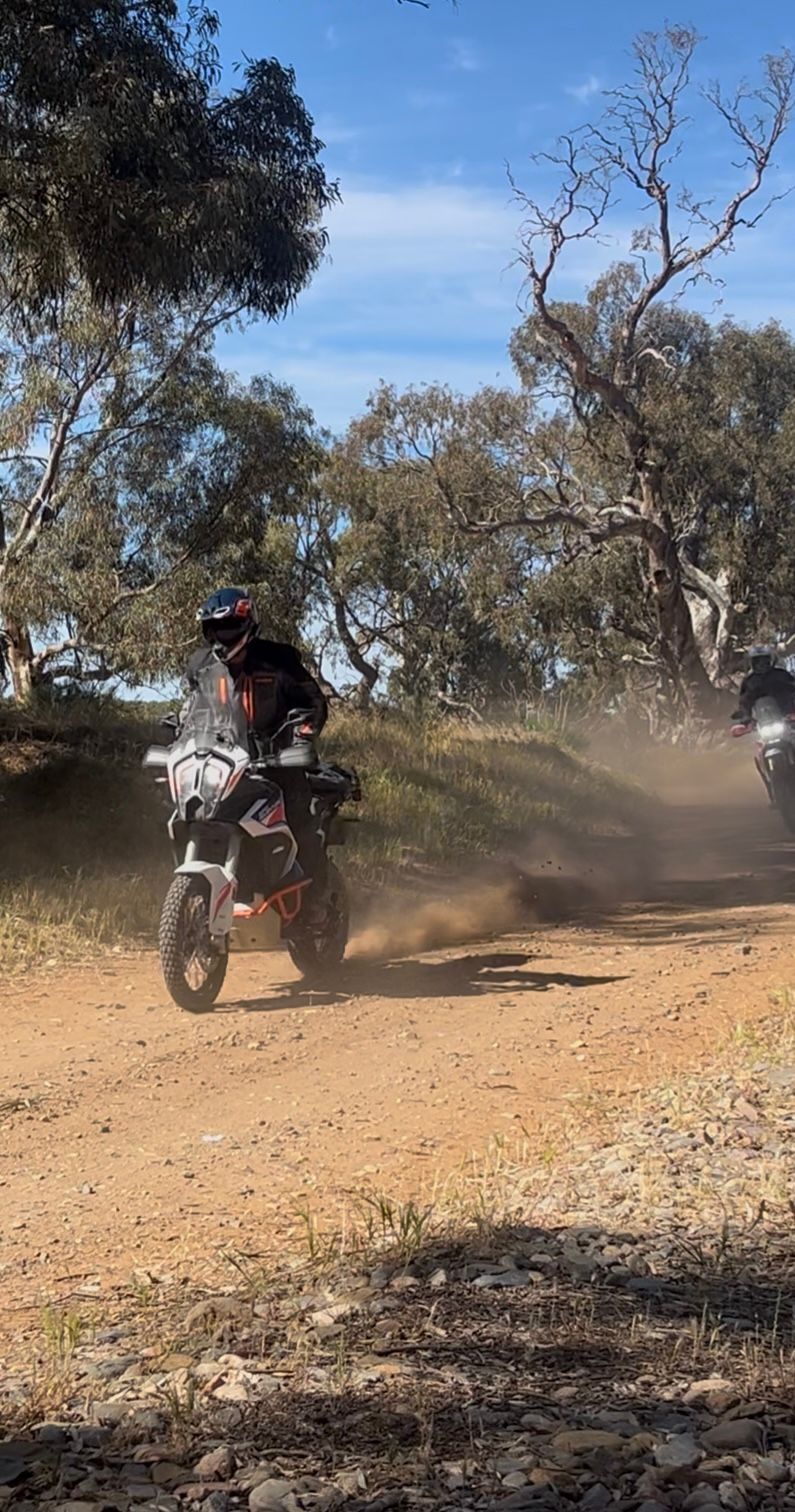
The handlebars move around. The front tyre seems to have developed a mind of its own. You hear stones hitting the bash plate. There's dust behind you and, quite possibly, somebody on an adventure bike disappearing into the distance ahead.
Welcome to gravel riding.
And here's the first thing we'd like you to know:
You don't have to be good at it yet.
Nobody was on their first ride.
At Gravel Hound Adventures, we think gravel riding should be accessible to ordinary motorcyclists. You don't need a motocross background, a $30,000 motorcycle or the ability to powerslide around corners for the camera.
You need a suitable motorcycle, sensible riding gear, somewhere appropriate to practise and a willingness to learn.
The rest comes with kilometres.
________________________________________
Why Ride Gravel in the First Place?
If you've spent your motorcycling life riding sealed roads, you might reasonably wonder why anyone deliberately leaves them.
Then you do it.
Gravel roads open up an entirely different side of motorcycling.
Suddenly you're discovering places you previously rode straight past. Quiet country roads, forests, hills, old railway towns, lookout points, river crossings and little country pubs and bakeries that aren't necessarily on the quickest route between anywhere.
That's really what adventure riding is about.
It's not about conquering impossible terrain.
It's about discovering where that road goes.
And once you're comfortable riding gravel, the map suddenly becomes considerably bigger.
________________________________________
The Bike Will Move Around — Let It
This is probably the biggest surprise for riders encountering gravel for the first time.
The motorcycle moves underneath you.
On bitumen we're accustomed to the tyres feeling planted. Steering inputs are precise and the motorcycle generally goes exactly where we point it.
Loose gravel is different.
The front wheel can wander slightly.
The rear tyre can move sideways.
The handlebars can twitch.
The motorcycle may follow small ridges in the road.
For a new gravel rider, the natural reaction is to tense up.
You grip the handlebars harder.
Your shoulders tighten.
You try to force the motorcycle to behave.
Unfortunately, that usually makes things worse.
The motorcycle needs to move.
Hold the handlebars securely, but don't strangle them. Relax your arms and allow the front wheel to find its way through the loose surface.
It feels completely unnatural initially.
Then one day you realise the motorcycle has been moving around underneath you for the last ten kilometres and you haven't even thought about it.
That's progress.
________________________________________
Look Where You Want to Go
It sounds ridiculously simple.
It also works.
Your motorcycle has an uncanny ability to travel towards whatever you're staring at.
See a large pothole and stare directly at it?
There's a surprisingly good chance you're going to hit it.
Look at the gap beside it instead.
The same applies through corners.
Don't fixate on the loose gravel immediately in front of your wheel. Lift your vision and look through the corner towards where you want the motorcycle to go.
Your peripheral vision will deal with much of what's happening closer to the bike.
Good vision gives you more time to react.
And more time usually means less panic.
________________________________________
Slow Down Before the Corner
New gravel riders often discover that braking and turning don't feel quite as reassuring as they do on sealed roads.
That's because grip is less predictable.
The easiest solution is simple:
Get your speed under control before the corner.
Do most of your braking while the motorcycle is relatively upright.
Then enter the corner at a speed you're comfortable with.
As your confidence improves, your corner speed will naturally increase.
Don't chase it.
One of the worst things you can do as a beginner is enter a corner too quickly, panic, stare at the outside edge of the road and grab a handful of brake.
Slow in and comfortable is far better.
Nobody awards trophies at the end of a Saturday morning adventure ride.
________________________________________
Learn to Brake on Gravel
Some riders become frightened of using the front brake on gravel.
That's understandable, but avoiding it completely isn't the answer.
Your front brake remains extremely important.
The difference is how you use it.
On loose surfaces, sudden aggressive inputs can overwhelm available grip. Apply the brakes progressively and give the tyre an opportunity to work.
Practise braking somewhere safe.
Start slowly.
Brake gently.
Then repeat the exercise while gradually increasing the braking force.
Learn what the motorcycle feels like as the surface changes.
The rear brake can also be extremely useful, particularly at lower speeds, but don't fall into the trap of relying exclusively on it because you're afraid of the front.
Modern motorcycles may also have ABS and different riding modes. Understand how your particular motorcycle's system operates before you need it.
________________________________________
Standing Up Isn't Compulsory
Watch enough adventure motorcycle videos and you could be forgiven for thinking sitting down is illegal.
It isn't.
Standing on the footpegs can be extremely useful.
It allows your legs to absorb bumps, gives the motorcycle freedom to move beneath you and improves visibility on rougher terrain.
But you don't have to stand continuously.
On a smooth gravel road, sitting may be perfectly comfortable.
Stand when it helps.
Sit when it doesn't.
When you do stand, avoid pulling yourself up using the handlebars. Your weight should be supported primarily through your legs and footpegs.
Keep your knees slightly bent and your arms relaxed.
If you're hanging from the handlebars after two minutes, something isn't right.
________________________________________
Don't Try to Keep Up
This one matters.
You might be riding with people who have spent decades riding dirt bikes and adventure motorcycles.
They may disappear up the road.
Let them.
Ride at your own pace.
A good riding group won't pressure inexperienced riders to keep up.
At Gravel Hound Adventures, we'd much rather wait at the next junction for five minutes than have somebody riding beyond their ability trying to stay with the group.
Your speed will improve naturally.
Confidence gained gradually tends to stay with you.
Confidence borrowed from the rider in front can disappear very quickly.
________________________________________
Leave More Space
Gravel creates dust.
Sometimes a lot of it.
If you're following another motorcycle too closely, visibility can disappear almost instantly.
Increase your following distance.
That gives the dust time to clear and gives you more room if the rider ahead suddenly slows down.
It also means fewer stones hitting you and the motorcycle.
On particularly dusty roads, spacing riders further apart can transform the ride.
There's no prize for arriving at the next junction three seconds behind the person in front.
________________________________________
Choose Your First Gravel Road Carefully
Your first gravel ride probably shouldn't involve deep sand, steep rocky climbs or 200 kilometres through the middle of nowhere.
Find a reasonably well-maintained gravel road.
Preferably somewhere with low traffic and good visibility.
Ride ten or twenty kilometres.
Turn around.
Ride it again.
You'll often be noticeably more comfortable on the return journey because you already know what to expect.
As your confidence develops, gradually introduce more challenging surfaces.
Adventure riding isn't a test you have to pass.
There are no levels to unlock.
Build your skills at your own pace.
________________________________________
Tyres Matter — But Don't Become Obsessed With Them
Adventure riders love discussing tyres.
Give five riders ten minutes and you'll probably get seven tyre recommendations.
A road-biased adventure tyre can handle good-quality gravel surprisingly well.
A more aggressive tyre will generally provide greater confidence as conditions become loose, muddy or sandy, but there are compromises in areas such as road behaviour, noise and longevity.
For your first few gravel rides, don't assume you immediately need the most aggressive tyre available.
Learn what your current tyres can do.
Then choose your next set based on the riding you're actually doing rather than the riding you imagine you might do one day.
________________________________________
What About Tyre Pressures?
This is another subject capable of starting a lengthy argument around a campfire.
Lowering tyre pressures can improve grip and compliance in some off-road conditions, but going too low can increase the risk of rim damage, punctures and other problems.
There isn't one magic pressure that suits every motorcycle, tyre, rider, load and road surface.
For a new rider exploring ordinary maintained gravel roads, don't start dramatically changing pressures simply because somebody on the internet told you to.
Start with the motorcycle and tyre manufacturers' guidance.
As you gain experience, you can learn how different pressures affect your particular motorcycle.
And carry a tyre gauge and inflation method if you're changing pressures during a ride.
________________________________________
Gravel Roads Change Constantly
Never assume the next corner will have the same surface as the last one.
A beautiful hard-packed gravel road can suddenly become loose.
A grader may have been through.
There might be corrugations.
Rain can create washouts.
Heavy vehicles can form deep ruts.
You might find sand deposited across a corner or loose stones pushed into the outside wheel track.
That's why reading the road ahead is such an important adventure riding skill.
Don't just look at where the road goes.
Look at what the road is made of.
________________________________________
Beware of the Gravel Windrow
One feature new riders quickly discover is the ridge of loose gravel that can develop between vehicle wheel tracks or along the centre of the road.
Eventually you'll need to cross one.
The first few times can feel uncomfortable.
Don't stare at it.
Don't make a sudden dramatic steering input.
Keep the motorcycle reasonably settled, look where you want to go and cross the loose material smoothly.
The bike may wriggle.
That's okay.
Remember our first lesson?
Let it move.
________________________________________
Corrugations
Eventually you'll find them.
Kilometre after kilometre of small ridges capable of shaking fillings from teeth you didn't know had fillings.
Corrugations can make the motorcycle feel harsh and unsettled.
Again, stay relaxed.
Avoid gripping the bars tightly.
Sometimes a modest change in speed can noticeably change how the motorcycle behaves over corrugations, but never increase speed beyond what is safe simply because the ride feels smoother.
If conditions become uncomfortable, slow down.
Adventure riding isn't an endurance competition.
________________________________________
Cars and Four-Wheel Drives
Gravel roads aren't racetracks.
They're public roads.
You may encounter cars, four-wheel drives, farm vehicles, cyclists, animals and trucks.
Stay on your side of the road, particularly approaching blind corners and crests.
Don't assume nothing is coming simply because you haven't seen another vehicle for twenty minutes.
A large four-wheel drive appearing around a blind corner can occupy considerably more road than you were expecting.
Leave yourself somewhere to go.
________________________________________
Expect to Drop the Bike Eventually
We might as well talk about it.
Adventure bikes occasionally lie down.
Sometimes quite enthusiastically.
It happens to experienced riders as well as beginners.
A slow-speed drop doesn't automatically mean you've failed.
If anything, the first scratch can be strangely liberating.
Obviously, we want to avoid crashes and injuries, but don't allow fear of dropping the motorcycle to stop you learning.
Crash bars and handguards can help protect vulnerable components.
More importantly, practise low-speed control somewhere safe.
The better your balance and clutch control become, the fewer times you'll need those crash bars.
________________________________________
Ride With People Who Want You There
This might be the most important advice in the entire article.
Choose your riding companions carefully.
A good group makes adventure riding enormously enjoyable.
A bad one can destroy a beginner's confidence in a single afternoon.
Experienced riders should remember that they were beginners once.
Nobody should be mocked for riding slowly.
Nobody should feel pressured into attempting terrain they aren't comfortable with.
Nobody should be abandoned at the back of the group.
And if someone needs help picking up a motorcycle, you help them.
That's what riding mates do.
________________________________________
You Don't Need the Biggest Adventure Bike
It's easy to believe adventure riding requires a huge motorcycle covered in aluminium boxes, spotlights and enough electronics to communicate with the International Space Station.
It doesn't.
Smaller motorcycles can be fantastic adventure bikes.
They're often easier to manage at low speed, less intimidating on loose surfaces and considerably easier to pick up.
The right motorcycle is one that suits you, your experience and the type of riding you want to do.
Don't buy a motorcycle simply because somebody else says it's what "serious" adventure riders use.
There is no such rule.
________________________________________
Your First Gravel Ride Checklist
Before heading out, keep things simple.
Check your fuel.
Check your tyres.
Check your chain.
Take water.
Carry your phone.
Have navigation available.
Wear proper riding gear.
Tell someone roughly where you're going.
Carry basic tools and puncture equipment if you're heading any meaningful distance from home.
And don't make your first gravel ride a massive expedition.
Leave yourself wanting more.
________________________________________
The Most Important Skill Is Relaxing
Almost everything improves when you stop fighting the motorcycle.
Relax your grip.
Look further ahead.
Slow down before corners.
Use smooth inputs.
Let the motorcycle move underneath you.
And ride at your pace.
You'll make mistakes.
We still do.
That's part of riding motorcycles.
But something interesting happens after you've ridden a few hundred kilometres of gravel.
The movement that initially frightened you becomes normal.
You stop staring immediately in front of the wheel.
Your arms relax.
Your braking becomes smoother.
You start looking through corners.
And eventually you'll reach another section where the bitumen ends.
Except this time your reaction will be completely different.
Instead of wondering whether you should turn around, you'll probably smile inside your helmet.
Because that's where the interesting roads begin.
________________________________________
Welcome to the Pack
Gravel Hound Adventures isn't about being the fastest rider.
It isn't about having the most expensive motorcycle.
And it certainly isn't about pretending we're all Dakar competitors.
We're ordinary riders who enjoy motorcycles, gravel roads, exploring new places and having a laugh along the way.
If you're new to adventure riding, you're exactly the sort of rider we want to encourage.
Start with an easy road.
Take your time.
Learn something every ride.
And don't worry about keeping up.
We'll see you at the next junction.
Gravel Hound Adventures
Trained by Terrain.
Preparing for a Multi-Day Adventure A successful motorcycle trip begins long before you leave home. From servicing your bike and checking tyres to selecting tools, spares, luggage and camping equipment, good preparation can prevent small problems from ruining a great adventure. Read our practical preparation guide and discover how the Gravel Hound Adventure Ride Planner and Checklist can help you leave home properly prepared.
Preparing for a Multi-Day Adventure Motorcycle Trip
The preparation that happens before the ride can make the difference between an adventure and an ordeal
There is something special about loading an adventure bike, pointing it towards the horizon and knowing you won't be home that evening.
A multi-day motorcycle trip changes the game.
You're no longer simply heading out for a Saturday morning ride where a mechanical problem might mean an embarrassing phone call and a trailer ride home. Once you're several hundred kilometres away, perhaps on a remote gravel road with limited phone coverage, the consequences of poor preparation become considerably greater.
The good news is that you don't need to carry an entire motorcycle workshop with you.
You simply need to prepare properly, pack intelligently and understand what you are carrying.
After decades of riding motorcycles, one lesson keeps coming back:
Preparation rarely feels important until the moment you realise you should have done more of it.
Start Preparing Weeks Before the Trip
One of the biggest mistakes riders make is leaving preparation until the night before departure.
Suddenly the garage becomes a frantic mess of tools, luggage, tyre gauges, chargers and camping equipment while somebody tries to remember where they put the spare inner tube they bought six months ago.
Start several weeks beforehand.
Make a list of the jobs the motorcycle needs and gradually work through them.
Check when the bike was last serviced. Look at the remaining tyre life. Inspect the chain and sprockets. Check brake pads, wheel bearings and fluids.
If something looks questionable in your garage, it isn't going to improve after another 1,500 kilometres.
A simple four-week preparation schedule works well.
Four weeks out, identify anything that needs ordering or replacing.
Two weeks out, complete servicing and mechanical work.
One week out, organise tools, luggage and equipment.
During the final few days, load the motorcycle and conduct a proper test ride.
That approach removes most of the last-minute panic.
Know Where You're Going
Route preparation isn't simply loading a GPX file into your navigation system.
Before leaving, understand roughly where the route goes and what sort of country you'll be travelling through.
Look at:
Fuel availability
Distances between towns
Road surfaces
Possible water crossings
Weather forecasts
Accommodation or camping options
Food and water availability
Mobile phone coverage
Alternative routes
Fuel range becomes particularly important in regional Australia.
A service station shown on a map isn't necessarily open seven days a week — and occasionally it isn't there anymore.
Know the realistic range of your motorcycle and always leave yourself some margin.
Give the Motorcycle a Proper Inspection
Your motorcycle deserves more than a quick glance before a major trip.
Work methodically around the bike.
Check the tyres carefully for cuts, cracking, damage and remaining tread.
Inspect the wheels and spokes where applicable.
Check wheel bearings for movement.
Inspect brake pads and discs.
Check the chain for tight spots and make sure the sprockets aren't excessively worn.
Check coolant, engine oil and brake fluid.
Inspect hoses and electrical wiring.
Check battery terminals.
Make sure all lights work.
Then check important fasteners.
Adventure bikes spend their lives vibrating across corrugations and rough tracks. Bolts that have remained perfectly tight for months can suddenly decide to make a bid for freedom.
Crash bars, bash plates, luggage racks, exhaust brackets and handguards deserve particular attention.
Don't Make Major Changes Immediately Before Leaving
This is something I've learned the hard way over the years.
Avoid making major modifications to the motorcycle the night before departure.
If you've changed tyres, gearing, suspension settings, luggage systems or anything significant, ride the motorcycle beforehand.
Give yourself enough time to discover a problem.
A 30-minute test ride around the suburbs isn't always enough either.
Load the bike as you intend to travel and take it for a decent ride.
Find some gravel.
Try the brakes.
Stand on the pegs.
Check the steering.
Listen for rattles.
Make sure the luggage isn't moving.
It's far easier to fix something in your garage than beside a dirt road 600 kilometres from home.
Carry Tools That Fit Your Motorcycle
Buying a generic motorcycle toolkit and throwing it into your pannier isn't necessarily the answer.
Your toolkit should be designed around your motorcycle.
Go around the bike and identify the tools required to perform the jobs you're realistically capable of doing beside the road.
At a minimum you should be able to remove both wheels, adjust the chain, tighten common fasteners, access the battery and remove basic bodywork.
There's little point carrying three kilograms of tools that don't fit anything on your motorcycle.
Likewise, carrying a socket for your rear axle isn't particularly useful if you've forgotten the tool required for the front.
Before the trip, use your travelling toolkit to perform some basic maintenance at home.
You'll quickly discover what's missing.
Tyre Problems Are One of the Most Likely Problems You'll Face
Adventure riding and punctures have always been good friends.
Whether your motorcycle uses tubes or tubeless tyres, you need a realistic plan for dealing with a puncture.
Tubeless riders should carry a suitable plug kit and inflation system.
Tube-type riders need the correct tubes, tyre levers and the tools required to remove the wheels.
And owning the equipment isn't enough.
You need to know how to use it.
The side of a remote gravel road isn't the ideal location for your first attempt at removing a motorcycle tyre.
A compact electric pump can be worth its weight in gold.
Whatever system you choose, test it before leaving.
Carry Sensible Spares
There is always a temptation to prepare for every possible mechanical failure.
Don't.
If you attempt to carry enough equipment to rebuild the motorcycle beside the road, you'll end up needing another motorcycle just to carry the spares.
Concentrate on small, lightweight items that could realistically save a trip.
Depending on the motorcycle, these might include spare fuses, cable ties, electrical tape, spare bolts, a master link, puncture repair equipment and a small quantity of appropriate fluids.
Think about the problems that are reasonably likely rather than every theoretical possibility.
Recovery Equipment Matters
Mechanical problems aren't the only reason an adventure bike stops moving.
Sometimes the rider simply puts it somewhere motorcycles weren't designed to go.
A lightweight tow strap is extremely useful.
So are strong cable ties, tape and a few basic repair materials.
Adventure riders have been temporarily repairing motorcycles with cable ties and tape since long before anybody invented the phrase "adventure motorcycle."
The repair doesn't necessarily need to last forever.
Sometimes it simply needs to get you to the next town.
Travelling in a Group Changes What You Need to Carry
One advantage of travelling with other riders is that everyone doesn't need to carry everything.
Before departure, compare equipment.
There is little point in five riders carrying five identical electric tyre pumps while nobody has a tow strap.
Allocate some equipment across the group.
One rider might carry the comprehensive first-aid kit.
Another carries the tyre pump.
Someone else carries additional tools or recovery equipment.
However, there are certain things every rider should still carry personally, particularly water, essential medication, identification and basic emergency equipment.
If the group becomes separated, you don't want everything important disappearing over the horizon with somebody else.
Camping Equipment — Keep It Sensible
If you're camping, the same rule applies to camping equipment.
Weight and bulk matter.
A compact tent, sleeping system, basic cooking equipment and appropriate clothing are usually enough.
The temptation is always to pack for every possible situation.
Before long, the motorcycle looks as though you're moving house.
At Gravel Hound Adventures we're certainly not opposed to camping.
But when a perfectly respectable country hotel appears at the end of a long day's riding, it can be remarkably difficult to ride past it.
Particularly because adventure motorcycles have one serious design flaw:
their beer-carrying capacity is disappointingly limited.
Water Is Non-Negotiable
Never underestimate how much water you'll need.
On longer Australian rides, particularly during warmer weather, hydration should be treated as essential equipment.
A hydration bladder allows you to drink while riding and is one of the easiest ways to maintain hydration throughout the day.
Carry additional emergency water separately.
Electrolyte tablets or powder can also be useful during hot conditions or physically demanding riding.
And remember that your planned water stop may not always exist.
Carry enough to deal with the unexpected.
Electronics Need Planning Too
Modern adventure riders carry an impressive collection of electronics.
Phones, GPS units, cameras, helmet intercoms, action cameras and power banks all need charging.
Before leaving, work out how everything will remain powered.
Check the motorcycle's USB outlets.
Carry the correct cables.
Consider a power bank.
Download offline maps where possible.
Don't rely entirely on mobile phone coverage.
Technology is fantastic when it works.
It becomes considerably less impressive when the battery reaches 1%.
Pack the Motorcycle Carefully
Where you put the weight matters almost as much as how much weight you carry.
Heavy items should generally be kept low and as close to the centre of the motorcycle as practical.
Avoid putting excessive weight high behind the rear axle.
Adventure bikes already have plenty of weight at the back once luggage, camping gear and supplies are added.
Poorly distributed luggage can dramatically affect steering and suspension behaviour.
Once everything is loaded, check your suspension settings and tyre pressures.
Then ride the motorcycle.
Don't wait until departure morning to discover that it handles like a shopping trolley with a flat wheel.
The Final Loaded-Bike Test
Several days before departure, completely load the motorcycle.
Everything.
Tools.
Clothes.
Camping equipment.
Water.
Camera equipment.
Everything you intend to take.
Then go for a ride.
Use sealed roads and gravel if possible.
Accelerate hard.
Brake firmly.
Ride over some bumps.
Stand on the footpegs.
Check that nothing moves.
Then return home and reconsider everything you've packed.
Ask yourself one simple question:
Do I really need this?
You'll be surprised how much equipment suddenly finds its way back onto the garage shelf.
The Night Before Departure
The night before the trip should be remarkably boring.
That's the objective.
The motorcycle should already be serviced.
The luggage should already be organised.
Your route should already be loaded.
Electronics should be charging.
Documents should be ready.
Check the weather one final time.
Check fuel.
Check tyre pressures.
Check oil.
Check the chain.
Then leave the motorcycle alone.
If you're still fitting accessories at 11:30pm, something has gone wrong with the preparation process.
The Gravel Hound Multi-Day Bike & Equipment Checklist
To make this entire process easier, we've created the Gravel Hound Multi-Day Bike & Equipment Checklist.
It's an eight-page interactive checklist designed specifically around adventure motorcycle travel.
It covers:
Trip and motorcycle details.
A four-week preparation timeline.
Complete motorcycle inspection.
Bike-specific tools.
Roadside repair skills.
Tyre repair equipment.
Mechanical and electrical spares.
Recovery and emergency equipment.
Group equipment allocation.
Camping, cooking, food and water.
Riding gear and clothing.
Electronics and charging.
Luggage and weight planning.
The final loaded-bike test.
And final departure checks.
With more than 400 interactive fields and checkboxes, you can work through the preparation gradually rather than trying to remember everything the night before departure.
The idea isn't to tell you that you must carry everything listed.
Quite the opposite.
It's designed to make you think about what you actually need for your motorcycle, your route and your trip.
Preparation Creates Confidence
The objective of preparation isn't to eliminate every possible problem.
That's impossible.
Motorcycles break.
Tyres puncture.
Weather changes.
Roads close.
Riders make mistakes.
That's part of adventure travel.
Preparation simply improves your ability to deal with those situations when they happen.
And there's another benefit.
When you know the motorcycle has been properly checked, your tools fit the bike, your luggage has been tested and your essential equipment is packed, you stop worrying about the motorcycle.
You can concentrate on the reason you went in the first place.
The road.
The scenery.
The people you're riding with.
And whatever is waiting around the next corner.
Prepare the bike. Pack with purpose. Ride with confidence.
Gravel Hound Adventures — Trained by Terrain.
CFMOTO 450MT Long-Term Review: 22,000 km With the Desert Dingo After commuting, weekend gravel rides and a 10-day tour of Tasmania, has this affordable adventure bike proved it can run with the bigger machines? Michael shares an honest owner’s verdict on reliability, comfort, performance, modifications and the lessons learned over 22,000 kilometres.
CF MOTO 450MT Long-Term Review: 22,000 km
Has this affordable adventure bike proved itself—or merely survived?
When I bought my 2025 CFMOTO 450MT, I did so with a major motorcycle tour rapidly approaching and at least a few doubts in the back of my mind.
My Yamaha XT660Z Ténéré—the Blue Mule—was getting older. I was not entirely convinced that reliability would become a problem, but some of the other riders preparing for our Tasmania trip were considerably less optimistic.
With ten days of touring ahead, including long road sections, gravel, luggage and seven motorcycles relying on one another, the Tasmania deadline forced my hand.
I considered buying a Yamaha Ténéré 700. It was the obvious progression from the XT660Z and came with an established reputation. But then I rode the CFMOTO 450MT.
Any concern about it lacking sufficient power disappeared during the test ride. Once its AU$10,500 ride-away price was included in the calculation, the decision became almost impossible to argue against.
The Desert Dingo joined the Gravel Hound pack.
Twenty-two thousand kilometres later, it has commuted, carried out Blood Bike duties, completed regular 250-kilometre-plus weekend rides and toured Tasmania for ten consecutive days. It has travelled on sealed highways, flowing gravel roads, corrugations, rough tracks and everything in between.
More importantly, it has never failed to start, never stranded me and never required recovery.
So, was buying the 450MT a compromise?
After 22,000 kilometres, I would say absolutely not.
First impressions
The first things I noticed were the smooth acceleration and surprisingly pleasant exhaust note.
The engine felt polished from the beginning. There was no sense that it needed thousands of kilometres to loosen up or become enjoyable. Apart from the normal running-in period, I have not noticed any significant change in its character since it had approximately 100 kilometres on the odometer.
It was also immediately comfortable.
At five feet six inches tall, I fit the motorcycle particularly well. The riding position suits me both seated and standing in the attack position. I have not needed handlebar risers or major ergonomic changes.
The controls feel solid, the dashboard is clear and the bike feels considerably more substantial than its price might suggest.
That last point remains true after 22,000 kilometres. It still feels tight, plush and properly assembled.
Is there enough power?
This will probably be the first question asked by anyone considering the 450MT against a Ténéré 700, KTM 690, Aprilia Tuareg or larger adventure bike.
For the riding we do, the answer is yes.
The 450MT will lose some ground under hard acceleration against the larger motorcycles in our crew. That should surprise nobody. We regularly ride with Africa Twins, Ténéré 700s, KTM 690s and machines with considerably more horsepower.
However, during a normal 250-to-300-kilometre mixed-surface day, the CFMOTO holds its head high. In the right hands, it will go virtually anywhere the larger bikes go and keep up perfectly well.
The engine feels happiest higher in the rev range. It is smooth, willing and pleasant to use, but I prefer the flexibility created by taller gearing.
The standard 14-tooth front and 47-tooth rear gearing did not suit my combination of commuting, country roads, highway sections and flowing gravel. I initially changed to a 15-tooth front sprocket while retaining the 47-tooth rear.
That improved the bike, but it still did not achieve what I wanted at highway speeds.
I eventually arrived at 15/43 gearing, which has transformed the motorcycle for my purposes. It reduces engine speed and the sense of mechanical stress during highway sections without compromising the gravel-road performance that makes up much of our riding.
Would the taller gearing be ideal for technical single-track, steep climbs and hard enduro riding?
Probably not.
But that is not our game.
Our rides are increasingly built around distance: sealed transport sections, backroads, flowing gravel and occasional rougher tracks. For that combination, 15/43 is the sweet spot.
If CFMOTO offered me one engine improvement, I would ask for another 10–15 horsepower. Not because the existing engine is inadequate, but because a little more punch—and the ability to lift the front wheel when required—would make an already entertaining motorcycle even better.
It does not need 100 horsepower. But another ten or fifteen would be welcome.
Fuel economy and range
I am not someone who records every fuel receipt and calculates consumption to three decimal places. I generally fill the motorcycle when the fuel light appears and stop thinking about fuel until it appears again.
During our Tasmania tour, the dashboard average was approximately 4.1 litres per 100 kilometres.
In practical use, the 450MT offers excellent range. Around 350 kilometres is easy to plan around, and the displayed range can approach 400 kilometres depending on conditions.
That removes much of the fuel anxiety that can complicate country and remote-area riding.
Tasmania: the real test
The Tasmania trip was the reason I bought the motorcycle, so it became a serious test early in my ownership.
The tour covered roughly 4,700 kilometres from Adelaide back to Adelaide, including the Victorian transport sections, ferry crossing, Tasmania and the return through the Great Ocean Road, Mount Gambier and Kingston SE.
The 450MT carried a Mosko Moto Reckless 80 rackless luggage system, which proved perfect for the job.
Despite the luggage and consecutive long days, the motorcycle remained balanced, planted and completely capable. I looked forward to getting back on it every morning.
By approximately four o’clock most afternoons, I was ready to get off and have a beer—but that probably says more about the rider than the seat.
The standard seat is excellent. I can ride all day without a problem, and I consider it every bit as comfortable as the old XT660Z Ténéré.
The windscreen also causes me no trouble. I generally leave it in its lowest position and do not notice buffeting or excessive wind pressure. However, at my height, windscreens have rarely caused me problems on any motorcycle during 50 years of riding.
The 450MT proved that it could be loaded, ridden for consecutive days and trusted far from home.
Sealed-road handling
On sealed roads, the motorcycle feels extremely well planted.
It is stable, predictable and more than capable of keeping pace with larger machines on typical country roads. The revised gearing also makes it comfortable on highway sections.
There is a tendency toward headshake at very high speed when using more aggressive knobbly tyres. I attribute this primarily to the tyres rather than the chassis. With the more road-oriented Mitas Enduro Trail tyres used in Tasmania, there was no headshake—even at speeds well beyond normal touring pace.
One of my most memorable moments on the bike involved an admittedly unwise 170 km/h contest with Wayne. It demonstrated that the 450MT was capable of more than enough speed, but it is not something I recommend repeating on a public road.
This is an adventure motorcycle, not a high-speed sports tourer.
Gravel and rough-road performance
Gravel is where the 450MT makes the strongest argument for itself.
It is exceptionally good on fast, flowing unsealed roads. It feels planted, responsive and easy to position.
Like most motorcycles, it can feel slightly skittery on loose marble-like gravel, but I do not consider that a specific 450MT weakness. Loose stones on a hard surface will make almost any motorcycle move around.
The suspension performs well during general gravel and backroad riding. Its limitations become apparent when encountering deep holes or successive large hits. In those conditions, the suspension can bottom and bounce rather than maintaining full control.
Better damping and higher-quality suspension components would improve the motorcycle, particularly across corrugations and repeated impacts.
However, price must remain part of the discussion. At $10,500 ride-away, I cannot reasonably expect premium competition suspension.
The standard setup is entirely adequate for the riding the motorcycle was designed to do. It simply reaches its limits when asked to behave like a hard-enduro or motocross machine.
The fork incident
The most serious mechanical incident during my ownership involved the front forks jamming completely.
Initially, this looked like a potentially serious motorcycle failure. After investigating, however, I believe the problem resulted from a washer being omitted when I reassembled the forks following a seal replacement.
That allowed a spacer tube to split and become jammed inside the fork tube. The damaged component could not be removed without risking further damage, so I replaced the complete fork leg.
The replacement unit cost approximately $960 and even arrived filled with fork oil.
I completed the repair myself and did not pursue a warranty claim because the evidence suggested the problem was caused by my own assembly error, not a manufacturing defect.
It has not changed my opinion of the motorcycle or its durability.
We put it down to my stupid mistake, repaired it and moved on.
An honest long-term review must distinguish between a motorcycle failure and an owner-induced problem. In this case, I do not blame CFMOTO.
Brakes
My initial impression was that the front brake lacked feel and might be one of the motorcycle’s weak points.
With more time, I have adjusted my opinion.
The rear brake is good, and the front brake is adequate for the motorcycle. It stops the bike effectively and has not become a meaningful problem in everyday use.
That said, if CFMOTO wanted to improve the next model, a stronger front brake with more feedback would be high on my list.
The existing brake works. I would simply prefer more feel and authority.
Weight and confidence
The 450MT’s manageable weight is one of its biggest advantages.
It is lighter and easier to manoeuvre than several motorcycles in our group. That matters on gravel, but it also helps when I am moving around the Pack to film or photograph other riders.
Compared with the XT660Z, the CFMOTO feels lower, lighter and more responsive. Those qualities have increased my confidence off-road.
The old Ténéré was a comfortable and much-loved motorcycle with plenty of character. It remained in production for years and built a strong reputation. The 450MT cannot instantly manufacture that same history.
But in practical ability, the CFMOTO is at least its equal.
It is equally comfortable, just as capable on the highway with the revised gearing, better on gravel and rougher terrain, and noticeably easier to manoeuvre.
Controls and electronics
The dashboard is clear, easy to read and provides the information I need.
The switchgear feels solid. One particularly useful feature is the ability to turn traction control on and off while moving. Some considerably more expensive adventure motorcycles cannot do this, yet CFMOTO has made it simple.
The ABS and traction-control settings resetting after the motorcycle is restarted initially seemed annoying, but I have adapted to it and no longer consider it a significant issue.
My main switchgear complaint is the high-beam switch. Its position makes it too easy to activate with a slight, unintended touch of a gloved hand.
This is a relatively small issue, but one I would like CFMOTO to change.
Commuting and Blood Bike work
The 450MT is not used solely for weekend adventures.
It is also a practical commuter and works well for Blood Bike courier duties with a 50-litre top box fitted. The box remains on the motorcycle approximately 95 per cent of the time.
The smooth engine, manageable height, comfortable riding position and excellent range make it easy to use regularly.
It does not feel like a highly specialised motorcycle that must be endured during ordinary riding in return for occasional off-road ability. It works equally well during the week and on a long weekend ride.
Accessories and modifications
The Desert Dingo currently has or has used:
Radiator guard
Header guard
Upgraded bash plate
Upper and lower crash bars
Passenger-peg removal
Modified exhaust bracket
Foam air filter and pre-filter
15/43 gearing
50-litre top box
A tail tidy and side-stand enlarger were considered but have not been fitted.
The foam filter and gearing changes have delivered the biggest practical benefits. The bash plate and header protection are also non-negotiable for the way I use the motorcycle.
I would fit the same modifications again.
The aftermarket pannier racks did eventually snap during a particularly rough section while the top box was fitted. The leverage created by the loaded top box was more than the racks could tolerate.
Used correctly with suitable soft luggage such as the Mosko Moto system, the racks had been adequate. I consider the failure a consequence of the load and conditions rather than evidence of a fundamental motorcycle problem.
Servicing and running costs
Routine servicing has been straightforward.
An oil-and-filter change costs approximately $115 when I complete the work myself, with some oil left over.
My main maintenance complaint is that the bash plate must be removed to drain the oil and replace the filter. I would prefer proper service access without removing the protection every time.
The foam air filter and pre-filter should reduce long-term servicing costs and make filter maintenance easier.
The original chain and sprockets were replaced at approximately 19,000 kilometres. By that stage, the chain was badly worn.
The wheel bearings remained in good condition when checked at 21,000 kilometres.
I have experienced no difficulty obtaining replacement parts. Everything I have needed has been available from stock.
There has also been no concerning corrosion, fading or general deterioration. The motorcycle is stored undercover overnight, although it spends around 40 per cent of its daytime use parked outdoors in the elements.
At 22,000 kilometres, it still feels tight and plush.
Tyres
The Mitas Enduro Trail tyres used for Tasmania were excellent and long-lasting.
For my regular riding, my preferred option is now the Mitas Enduro Trail XT. They suit the combination of sealed roads, gravel and rougher weekend riding that defines the bike’s normal use.
Tyre choice can also influence the 450MT’s high-speed stability. More road-oriented tyres eliminated the headshake experienced at very high speeds with aggressive knobbies.
Reliability
This is the section many prospective owners will be waiting for.
Before buying, I did have concerns about longevity. At the price, and given some riders’ preconceptions about Chinese motorcycles, it was reasonable to wonder whether the savings would eventually appear in reliability or build quality.
So far, they have not.
In 22,000 kilometres, the 450MT has:
Started first time, every time
Never stranded me
Never required recovery
Completed a major interstate tour
Carried luggage over consecutive long days
Handled regular 250-kilometre-plus weekend rides
Worked as a commuter and Blood Bike courier
Shown no concerning corrosion or premature deterioration
Remained tight and well assembled
The fork problem appears to have resulted from my own assembly mistake. The broken pannier rack was an aftermarket accessory subjected to unsuitable leverage and rough conditions.
Neither represents a fundamental CFMOTO failure.
At this point, my concerns about reliability and longevity have largely been put to bed.
Should I have bought the T7?
No.
I have never regretted choosing the 450MT instead of spending considerably more on a Yamaha Ténéré 700.
The T7 offers more power, a strong reputation and an established name. It may also be the better motorcycle for some riders.
But the CFMOTO does everything I require.
It tours comfortably, handles gravel extremely well, carries luggage, commutes, provides excellent range and runs alongside much larger motorcycles without embarrassment.
A higher purchase price would not necessarily have produced more enjoyment.
Who should buy one?
The 450MT is particularly well suited to shorter riders, but its appeal is much broader.
It would make an excellent motorcycle for:
New adventure riders
Intermediate riders building confidence
Experienced riders wanting something lighter
Commuters who also ride on weekends
Solo tourers
Gravel-road riders
Riders who value manageable performance over headline horsepower
Anyone looking for strong value without buying a bare-bones motorcycle
Beginners and intermediate riders could gain a tremendous amount of confidence and experience from this bike.
Its combination of approachable height, manageable weight, smooth power and genuine capability makes adventure riding feel achievable.
Who should not buy one?
Look elsewhere if you want:
A high-speed highway touring motorcycle
Regular two-up touring with heavy luggage
A hard-enduro motorcycle
Premium competition suspension
Huge horsepower
The prestige of an established badge
The 450MT is not trying to be a sports tourer, superbike or enduro competition machine.
It is a practical, middleweight adventure motorcycle—and a very good one.
The three best things
After 22,000 kilometres, its strongest qualities are:
It starts first time, every time.
The engine accelerates smoothly and sounds surprisingly charming.
It combines comfort, manageable weight and real-world adventure capability exceptionally well.
What should CFMOTO improve?
My three requests would be:
Another 10–15 horsepower
A stronger front brake with more feel
Better-quality suspension damping and components
At the current price, however, these are improvement requests rather than serious complaints.
Final verdict
I expect to keep the Desert Dingo until at least 50,000 or 60,000 kilometres.
Would I set off on another major interstate trip tomorrow?
Absolutely.
If the motorcycle were stolen or destroyed, I would buy another 450MT.
That may be the clearest verdict possible.
After 22,000 kilometres, I give it nine out of ten. Better brakes and suspension are all that prevent it from scoring a perfect ten.
The 450MT has shown that a capable adventure motorcycle does not need to weigh 250 kilograms, produce more than 100 horsepower or cost a small fortune.
It needs to be comfortable, manageable, reliable and enjoyable.
The Desert Dingo is all of those things.
The CFMOTO 450MT has proved that you don’t need to spend a fortune or have more than 100 horsepower to own an extremely capable and enjoyable adventure motorcycle.
And after 22,000 kilometres, I am still looking forward to the next ride.
Gravel Hound Adventures — Trained by Terrain.